Optimization of Lightweight, Sustainable Growing Media for Mizuna (Brassica rapa cv. Japonica) and Amaranthus (Amaranthus viridis) under Stimulated Space Stations Microclimate
Ashita Mitra
*

Department of Horticulture, Naini Agricultural Institute, Sam Higginbottom University of Agriculture, Technology and Sciences (SHUATS), Prayagraj – 211007, Uttar Pradesh, India.
Samir Ebson Topno
Department of Horticulture, Naini Agricultural Institute, Sam Higginbottom University of Agriculture, Technology and Sciences (SHUATS), Prayagraj – 211007, Uttar Pradesh, India.
Vijay Bahadur
Department of Horticulture, Naini Agricultural Institute, Sam Higginbottom University of Agriculture, Technology and Sciences (SHUATS), Prayagraj – 211007, Uttar Pradesh, India.
Shilpa Rana
Department of Horticulture, Naini Agricultural Institute, Sam Higginbottom University of Agriculture, Technology and Sciences (SHUATS), Prayagraj – 211007, Uttar Pradesh, India.
*Author to whom correspondence should be addressed.
Abstract
Long-duration space missions require reliable fresh-food production systems because the nutritional quality of stored foods may decline during extended storage. This study evaluated eight soilless substrate formulations comprising cocopeat, perlite, moss grass, and rice husk charcoal for the cultivation of mizuna (Brassica rapa cv. japonica) and green amaranth (Amaranthus viridis) under a simulated space-station microclimate. The growth chamber was maintained at 15–25 °C, 75–95% relative humidity, a photosynthetic photon flux density of 500–600 µmol m⁻² s⁻¹, and a 10 h light/14 h dark photoperiod. Nine treatments, including a soil control, were arranged in a randomised block design with three replications. Growth, yield, nutritional quality, substrate temperature and pH, and tray mass were assessed. Treatment T7, consisting of 50% cocopeat and 50% rice husk charcoal, recorded the highest reported values for vitamin C, calcium, phosphorus, crude fibre, and iron in amaranth. Mizuna fresh herbage yield was highest under T4 (30% moss grass + 30% perlite + 40% charcoal), whereas T8 (50% moss grass + 50% charcoal) generally showed the poorest performance. All soilless media reduced tray mass by more than 80% relative to soil. Overall, T7 provided a favourable balance of nutritional quality, near-neutral pH, root-zone temperature, and low substrate mass. Further validation under microgravity or partial-gravity conditions is required.
Graphical Abstract: Schematic representation of cocopeat–charcoal substrate (T7) supporting Mizuna and Amaranthus microgreens in a controlled ecological life support system (CELSS) module under a simulated space-station microclimate.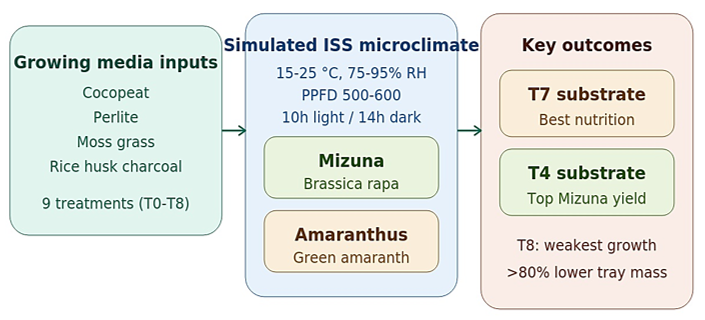
Keywords: Space agriculture, Mizuna, Amaranthus, growing media, microgreens, bioregenerative life support, CELSS, nutritional quality