Applications of Molecular Biology and Genomic Technologies in Modern Aquaculture: Current Advances and Future Perspectives
Ramzy A. Yousif *
Department of Fisheries and Wildlife Science, Sudan University of Science and Technology, P.O. Box-204, Khartoum, Sudan.
Omer. A. Idam
Department of Fish Production and Technology, Faculty of Animal Production, University of Gezira, Madani, Postal Code: 11111, Sudan.
E. A. T Mubarak
Department of Fisheries Science, College of Natural Resources & Environmental Studies, University of Bahri, Khartoum, 11111, Sudan.
F. S. Abdalla
Department of Fish Production and Technology, Faculty of Animal Production, University of Gezira, Madani, Postal Code: 11111, Sudan.
Fouzi. A Mohamed
Department of Fisheries and Wildlife Science, Sudan University of Science and Technology, P.O. Box-204, Khartoum, Sudan.
Samia H. Ahmed
Department of Fisheries and Wildlife Science, Sudan University of Science and Technology, P.O. Box-204, Khartoum, Sudan.
H. M. A. Sulieman
Department of Biology, College of Science in Yanbu, Taibah University, Yanbu Governorate, Saudi Arabia.
Hassan M. Yagoub
Department of Fisheries and Wildlife Science, Sudan University of Science and Technology, P.O. Box-204, Khartoum, Sudan.
*Author to whom correspondence should be addressed.
Abstract
Aquaculture, the world’s fastest-growing food production sector, plays a pivotal role in ensuring global food security and meeting the increasing demand for high-quality protein. Despite its rapid expansion, the industry continues to face significant challenges, including disease outbreaks, environmental stressors, and inefficiencies in feed utilization, which can limit productivity and sustainability. The advance of molecular biology and high-throughput genomics has revolutionized modern aquaculture by enabling precise and targeted approaches to improve breeding, health management, and nutritional efficiency.
A systematic literature survey was conducted using major scientific databases, including Scopus, Web of Science, and Google Scholar, focusing on peer-reviewed articles published between 2010 and 2024. Studies were selected based on their relevance to molecular biotechnology applications in aquaculture, particularly those addressing genomics, molecular diagnostics, gene expression analysis, DNA barcoding, and genome editing technologies.
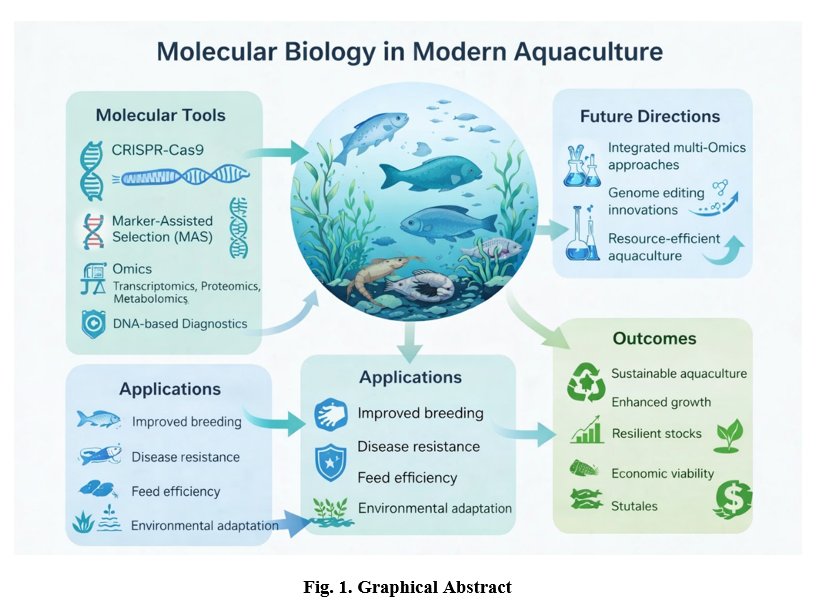
This review provides a comprehensive overview of the current applications of molecular biology in aquaculture, including Marker-Assisted Selection (MAS), high-resolution disease diagnostics, transcriptomics, proteomics, and nutrigenomics, highlighting their contributions to enhancing growth performance, disease resistance, and overall aquaculture sustainability. Additionally, the review explores emerging technologies, such as genome editing using CRISPR-Cas9 and integrated “Omics” approaches, which offer unprecedented opportunities to develop robust and resource-efficient aquatic species with improved traits. By synthesizing recent literature up to 2024, this article emphasizes the transformative potential of molecular tools in shaping the future of aquaculture. Ultimately, the integration of molecular biology into aquaculture practices holds promise not only for optimizing productivity but also for promoting environmentally sustainable, economically viable, and resilient aquatic production systems. The insights provided herein aim to guide researchers, industry stakeholders, and policymakers in leveraging molecular biology for the development of next-generation aquaculture practices. Despite these advances, challenges remain regarding technological accessibility, regulatory frameworks, and the integration of molecular tools into routine aquaculture practices. Future research should focus on expanding genomic databases for commercially important species and promoting the practical implementation of advanced molecular technologies to support sustainable aquaculture production.
Keywords: Aquaculture, DNA, genome editing, genomic selection, CRISPR-Cas9, molecular biology, molecular diagnostics, nutrigenomics