Lavicidal Effect of Green Synthesized Silver Nanoparticles against Aedes aegypti Larvae
Pushpa Kumari
*

College of Fisheries, Bihar Animal Sciences University, Kishanganj – 855107, Bihar, India.
Sudeshna Sarker
College of Fisheries, Bihar Animal Sciences University, Kishanganj – 855107, Bihar, India.
Bhartendu Vimal
College of Fisheries, Bihar Animal Sciences University, Kishanganj – 855107, Bihar, India.
Ankit Bhushan
College of Fisheries, Bihar Animal Sciences University, Kishanganj – 855107, Bihar, India.
V.P. Saini
College of Fisheries, Bihar Animal Sciences University, Kishanganj – 855107, Bihar, India.
*Author to whom correspondence should be addressed.
Abstract
Aims: The present study aimed to synthesize silver nanoparticles using aqueous neem (Azadirachta indica) leaf extract, characterize them, and compare the larvicidal activity of the extract with that of the synthesized nanoparticles against Aedes aegypti larvae.
Study Design: Following completely randomized designs (CRD) the experiment was conducted, in triplicates.
Place and Duration of Study: Dept. of Aquatic Animal Health Management, at college of Fisheries, Kishanganj, between May 2023 and August 2024.
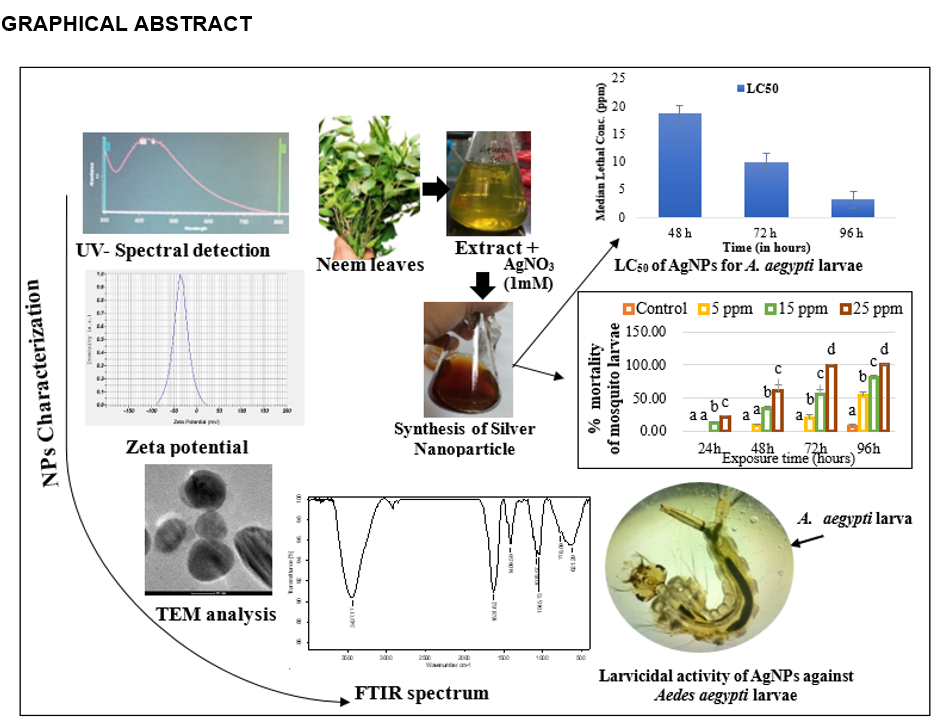
Methodology: Neem leaves collected, processed, and by heating aqueous extracts was prepared, followed by adding extract to silver nitrate (1mM) the silver nanoparticles were prepared. The physicochemical characteristics of green synthesized AgNPs was analysed (UV-Vis spectra, Dynamic Light Scattering, TEM, SEM and Fourier Transform Infrared (FTIR) analysis at SAIF-IIT, Bombay). The mosquito larvae recovered from fish tank exposed to different concentrations of AgNPs and neem leaf extracts and based on mortality following Probit analysis median lethal concentration (LC50) was calculated. All the data were analysed using one way ANOVA, (Statistical tool-SPSS, version 22).
Results: The biosynthesized AgNPs showed a maximum absorption peak at 420 nm, with a zeta potential of –45.5 mV. TEM and SEM analyses revealed spherical, monodispersed nanoparticles with an average size range of 5-50 nm, while FTIR analysis confirmed the presence of various functional groups conjugating with the AgNPs. Larvicidal bioassays demonstrated significantly higher mortality of A. aegypti larvae (p=0.05), achieving 100% mortality at a low concentration of 25 ppm within 96 h, compared to 1000 ppm for neem leaf extract. Mortality rates were also significantly higher at elevated AgNP concentrations compared to the control and other treatments. The estimated 96 h LC₅₀ values were 3.22 ppm for green-synthesized AgNPs and 381.94 ppm for aqueous neem leaf extract.
Conclusion: AgNPs showed greater larvicidal efficacy than aqueous neem extract against A. aegypti larvae, suggesting their potential as an eco-friendly alternative to chemical controls, however, the safety validation of AgNPs under field conditions need to be studied thoroughly.
Keywords: Green synthesis, neem leaf, AgNPs, characterization, Aedes aegypti, larvicidal effects